Evaluation of Morphometric Characters of the Pieris canidia and Danaus chrysippus Butterflies in different geographical area in Uttar Pradesh and Uttarakhand
Keywords:
Danaus chrysippus, Geographical area, Morphometric analysis, Pieris canidiaAbstract
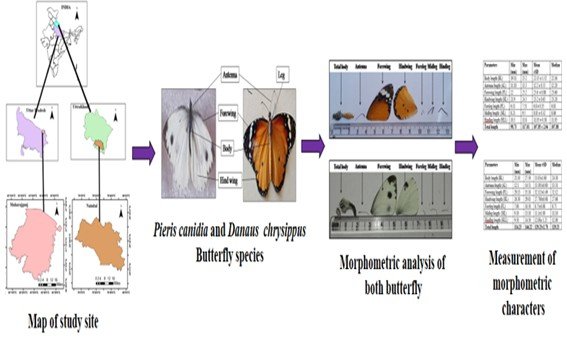
The purpose of this study was to describe the morphometric features of the butterflies Pieris canidia and Danaus chrysippus, such as their morphometric lengths. Butterflies were collected at random from the Sohagi Barwa Wildlife Sanctuary in the Maharajganj and the Himalaya Botanical Garden in Nainital, Uttarakhand. We used a Canon 750D DSLR camera to take the pictures of the butterflies. We used ImageJ software (1.48v) to measure seven different morphometric lengths from the Body length (BL), Antenna length (AL), Forewing length (FL), Hindwing length (HL), Foreleg length (FL), Midleg length (ML), and Hindleg length (HLL). The measurement of morphometric length of two butterfly species Pieris canidia and Danaus chrysippus. The mean length was recorded as 22.15 ± 1.52 mm, 12.2 ± 0.55 mm, 23.6 ± 0.88 23.2 ± 0.65, 6.8 ± 0.35 mm, 8.85 ± 0.32 and 11.05 ±0.38 mm in Body length (BL), Antenna length (AL), Forewing length (FL), Hindwing length (HL), Foreleg length (FL), Midleg length (ML), and Hindleg length (HLL) respectively, in the P. canidia butterfly. The mean length was recorded as 11.05±1.60 mm, 13.305±0.60 mm, 32.115±1.49mm, 27.700±0.68 mm, 8.75±0.88 mm, 11.1±1.00 mm in Body length (BL), Antenna length (AL), Forewing length (FL), Hindwing length (HL), Foreleg length (FL), Midleg length (ML), and Hindleg length (HLL) respectively, in D. rysippus the butterfly.Downloads
References
Akand, S., Bashar, M., Rahman, S., & Khan, H. (2018). Morphometric variation in the species of two subfamilies of lycaenid butterflies (Lepidoptera: Lycaenidae) of Bangladesh. Journal of Biodiversity Conservation and Bioresource Management, 3(1), 9-16. https://doi.org/10.3329/jbcbm.v3i1.36756.
Ashton, S., Gutierrez, D., & Wilson, R. J. (2009). Effects of temperature and elevation on habitat use by a rare mountain butterfly: implications for species responses to climate change. Ecological Entomology, 34(4), 437-446. https://doi.org/10.1111/j.1365-2311.2008.01068.x.
Azrizal-Wahid, N., Mohd Noor, N., Mamat, N., & Ain Izzati Mohd Zainudin, N. (2023). Length-Based Morphometric Study of the Morphologically Resembling Butterfly Species Within the Genus Graphium (Lepidoptera: Papilionidae). Andalasian International Journal of Entomology, 1(01), 8-15. https://doi.org/10.25077/aijent.1.01.8-15.2023.
Azrizal-Wahid, N., Sofian-azirun, M. and Rizman-idid, M. (2016). The significance of wing and body morphometry in discriminating six species of Eurema butterflies (Lepidoptera: Pieridae) of peninsular Malaysia. Sains Malaysiana, 45,10. https://knova.um.edu.my/research_publications_2016_2020/757/
Azrizal-Wahid, N., Sofian-Azirun, M., & Rizman-Idid, M. (2015). A review on morphological characterization, variation and distribution pattern of Eurema butterflies of Peninsular Malaysia. Journal of Biodiversity and Environmental Sciences, 6(3), 359-372.
Bashar, M. (2018). Vision on biodiversity: ecotourism and biodiversity conservation in Bangladesh. Journal of Biodiversity Conservation and Bioresource Management, 4(1), 1-10. https://doi.org/10.3329/jbcbm.v4i1.37871.
Baylac, M. C. V., & Simbolotti., G. (2003). Combing geometric morphometrics with pattern recognition for the investigation of species complex. 80(1), 89-98. https://doi.org/10.1046/j.1095-8312.2003.00221.x.
Bonebrake, T. C., Ponisio, L. C., Boggs, C. L., & Ehrlich, P. R. (2010). More than just indicators: a review of tropical butterfly ecology and conservation. Biological conservation, 143(8), 1831-1841. https://doi.org/10.1016/j.biocon.2010.04.044
Bonifacino, M., Pasquali, L., Sistri, G., Menchetti, M., Santini, L., Corbella, C., ...&Dapporto, L. (2022). Climate change may cause the extinction of the butterfly Lasiommatapetropolitana in the Apennines. Journal of Insect Conservation, 26(6), 959-972. https://doi.org/10.1007/s10841-022-00441-z
DeVries, P. J., Penz, C. M., & Hill, R. I. (2010). Vertical distribution, flight behaviour and evolution of wing morphology in Morpho butterflies. Journal of Animal Ecology, 79(5), 1077-1085. https://doi.org/10.1111/j.1365-2656.2010.01710.x
Digo, E. O., Abad, K. L. M., Guino-o, I. J. B., Samillano, L. K. C., Eduque Jr, R. M., Torres, M. A. J., &Requieron, E. A. (2015). Application of geometric morphometrics in the body shapes of flying fish (Parexocoetusbrachypterus) in Maitum, Sarangani Province. Aquaculture, Aquarium, Conservation & Legislation, 8(6), 1027-1034. https://www.cabidigitallibrary.org/doi/pdf/10.5555/20163018862
Evans, W. H. (1926). The Identification of Indian Butterflies, 2nd ed.; Bombay Natural History Society: Mumbai, India, 31, 49-83. https://biostor.org/reference/235627
Forister, M., Pelton, E., & Black, S. (2019). Declines in insect abundance and diversity: We know enough to act now. Conservation Science and Practice, 1(8). https://doi.org/10.1111/csp2.80.
Hill, G. M., Kawahara, A. Y., Daniels, J. C., Bateman, C. C., &Scheffers, B. R. (2021). Climate change effects on animal ecology: butterflies and moths as a case study. Biological Reviews, 96(5), 2113-2126. https://doi.org/10.1111/brv.12746
Kingsolver, J. G., & Buckley, L. B. (2018). How do phenology, plasticity, and evolution determine the fitness consequences of climate change for montane butterflies? Evolutionary Applications, 11(8), 1231-1244. https://doi.org/10.1111/eva.12618
Kunte, K. (2000). India, a Lifescape: butterflies of peninsular India. Universities Press. https://www.universitiespress.com/details?id=9788173718335
Landmark based geometric morphometric analysis of wing shape in Sibiricobombus Vogt (Hymenoptera: Apidae: Bombus Latreille). In Annales de la Société entomologique de France, 43(1), 95-102. https://doi.org/10.1080/00379271.2007.10697499.
Le Roy, C., Debat, V., & Llaurens, V. (2019). Adaptive evolution of butterfly wing shape: from morphology to behaviour. Biological Reviews, 94(4), 1261-1281. https://doi.org/10.1111/brv.12500.
Mahdi, S. H., Malo, S., Nesa, M., & Rahim, M. A. (2021). First report of morphometrics and length-length relationships of the common grass yellow butterfly, Euremahecabe (L.)(Lepidoptera: Pieridae). International Journal of Fauna and Biological Studies, 8(2), 01-05. https://doi.org/10.22271/23940522.2021.v8.i2a.802
Mahdi, S.H.A., Ferdous, M.E.M. and Ara, N., 2018. Assessment of morphometric characters of the Chiladespandavaand Chiladeslajus(Lepidoptera: Lycaenidae) butterflies. Scholars AcademicJournal of Biosciences, vol. 6, no. 6, pp. 459-464. 1413-1422. https://doi.org 10.21276/sajb.2018.6.6.4
Moradinour, Z., Wiklund, C., Jie, V. W., Restrepo, C. E., Gotthard, K., Miettinen, A., & Baird, E. (2021). Sensory organ investment varies with body size and sex in the butterfly Pierisnapi. Insects, 12(12), 1064. https://doi.org/10.3390/insects12121064
Nosil, P. (2012). Ecological speciation. Oxford University Press. Le Roy, C., Cornette, R., Llaurens, V., & Debat, V. (2019). Effects of natural wing damage on flight performance in Morpho butterflies: what can it tell us about wing shape evolution?. Journal of Experimental Biology, 222(16), 204057. https://doi.org/10.1242/jeb.204057
Singh, V. K., Joshi, P. C., & Gupta, S. K. (2020). Molecular and morphometric divergence of four species of butterflies (Nymphalidae and Pieridae) from the Western Himalaya, India. Molecular biology reports, 47(11), 8687-8699. https://doi.org/10.1007/s11033-020-05913-6
Von Schmalensee, L., Caillault, P., Gunnarsdóttir, K. H., Gotthard, K., & Lehmann, P. (2023). Seasonal specialization drives divergent population dynamics in two closely related butterflies. Nature Communications, 14(1), 3663. https://doi.org/10.1038/s41467-023-39359-8.
Watt, W. B. (2003). Mechanistic studies of butterfl y adaptations. In Boggs C., Watt W. & Ehrlich P. (eds): Butterfl ies: Ecology and Evolution Taking Flight.. University of Chicago Press.
Zattara, E. E., &Aizen, M. A. (2021). Worldwide occurrence records suggest a global decline in bee species richness. One Earth, 4(1), 114-123. https://doi.org/10.1016/j.oneear.2020.12.005
Downloads
Published
Issue
Section
License
Copyright (c) 2026 © Author(s)

This work is licensed under a Creative Commons Attribution 4.0 International License.