Agrotourism and Value-Added Products: A Business Model Innovation for Farm Retailing
Keywords:
Agripreneurial Resilience, Agrotourism (or Agritourism), Business Model Innovation (BMI), Service-Dominant (S-D) Logic, Short Food Supply Chains (SFSCs)Abstract
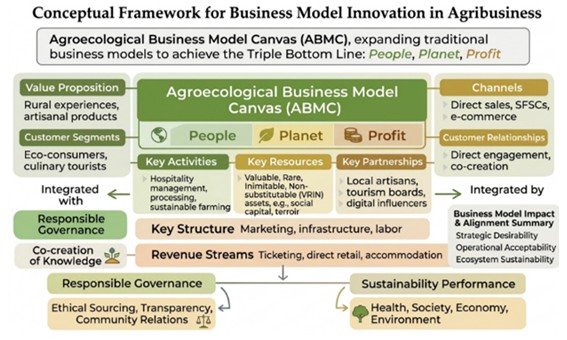
This research paper investigates the structural transformation of traditional farm retailing through the strategic integration of agrotourism and value-added agricultural products. Grounded in the Experience Economy paradigm, Service-Dominant (S-D) Logic, and the Resource-Based View (RBV) of the firm, the study addresses a critical research gap concerning the lack of integrated, scalable business model innovations explicitly designed for small-to-medium enterprise (SME) agripreneurs. Utilizing a rigorous TOWS Matrix analysis and Management by Objectives (MBO) framework, the methodology systematically maps the economic synergies between secondary food processing, tertiary experiential services, and Short Food Supply Chains (SFSCs). The empirical discussion focuses on resource-constrained, semi-arid environments—specifically the Thar Desert in Rajasthan, India—demonstrating how the strategic monetization of endemic, climate-resilient crops (e.g., Ker Sangri) through heritage tourism maximizes revenue per drop of water and fosters profound agripreneurial resilience. Key findings indicate that experiential value co-creation directly justifies premium retail pricing, insulates farms from global commodity market volatility, and successfully operationalizes the Triple Bottom Line. The paper concludes with actionable policy implications, emphasizing the necessity of digital integration, targeted legislative support (such as land-conversion waivers and tax reimbursements), and the establishment of robust capacity-building resource centers to secure sustainable rural economic revitalization.Downloads
References
Amanor-Boadu, V. (2003). Preparing for agricultural value-adding business initiatives: First things first. Agricultural Marketing Resource Center, Department of Agricultural Economics, Kansas State University, Manhattan.
Bhati, K., R. D. Pandya, & Kumar, M. (2025). TOWS Matrix Analysis: A Strategic Framework to the Sustainability of Farmer Producer Companies (FPCs). Journal of Agricultural Extension Management, 25(2), 27.
Campbell, J., & Kubickova, M. (2020). Agritourism microbusinesses within a developing country economy: A resource-based view. Journal of Destination Marketing & Management, 17, 100460. https://doi.org/10.1016/j.jdmm.2020.100460.
Drucker, P. F. (1954). The practice of management. Harper & Brothers.
Dukhaykh, S., & Alangri, N. (2026). Dynamic Capabilities and Sustainable Competitive Advantage in SMEs: The Roles of Innovation and Organizational Learning. Sustainability, 18(3), 1320. https://doi.org/10.3390/su18031320
Havlik, P., Veysset, P., Boisson, J.-M., Lherm, M., & Jacquet, F. (2005). Joint production under uncertainty and multifunctionality of agriculture: Policy considerations and applied analysis. European Review of Agricultural Economics, 32(4), 489-515 https://doi.org/10.1093/erae/jbi027
Osterwalder, A., & Pigneur, Y. (2010). Business model generation: A handbook for visionaries, game changers, and challengers. Wiley.
Pine, B. J., & Gilmore, J. H. (1999). The experience economy: Work is theatre & every business a stage. Harvard Business School Press.
Pitrova, J., Krejčí, I., Pilar, L., Moulis, P., Rydval, J., Hlavatý, R., Horáková, T., & Tichá, I. (2020). The economic impact of diversification into agritourism. International Food and Agribusiness Management Review, 23(5), 713-734. https://doi.org/10.22434/ifamr2020.0076.
Roman, M., & Kawęcki, N. (2024). Agritourism in academic research: Literature review and cluster analysis. Turyzm/Tourism, 34(1), 45-55. https://doi.org/10.18778/0867-5856.34.1.04.
Santeramo, F. G., & Barbieri, C. (2020). Agritourism and sustainability: A bibliometric analysis. Sustainability, 12(22), 9575. https://doi.org/10.3390/su12229575
Seckin, E., & Ozdil, G. G. (2022). Determination of the transition strategies to a sustainable and resilient city-region food system using the AHP-SWOT-TOWS methodology for Istanbul. Megaron, 17(2), 209–220. https://doi.org/10.14744/MEGARON.2022.12345
Srinidhi, A., et al. (2023). Retrospective climate resilience assessment of semi-arid farming systems in India. Agricultural Systems, 205, 103560. https://doi.org/10.1016/j.agsy.2023.103560
Tom Dieck, M. C., et al. (2018). The experience economy in tourism: A systematic literature review. Journal of Tourism Futures, 4(2), 173–188. https://doi.org/10.1108/JTF-12-2017-0069
Vargo, S. L., & Lusch, R. F. (2004). Evolving to a new dominant logic for marketing. Journal of Marketing, 68(1), 1-17. https://doi.org/10.1509/jmkg.68.1.1.24036
Vargo, S. L., & Lusch, R. F. (2016). Institutions and axioms: An extension and update of service-dominant logic. Journal of the Academy of Marketing Science, 44(1), 5–23. https://doi.org/10.1007/s11747-015-0456-3
Wilson, G. A. (2007). Multifunctional agriculture: A transition theory perspective. CABI. https://doi.org/10.1079/9781845932565.0000
Downloads
Published
Issue
Section
License
Copyright (c) 2026 © Author(s)

This work is licensed under a Creative Commons Attribution 4.0 International License.