Anthropogenic Impact on Water Quality and Phytoplankton Diversity in Pong Reservoir, Himachal Pradesh
Keywords:
Anthropogenic activities, Biodiversity, Phytoplankton, Pong reservoir, Water qualityAbstract
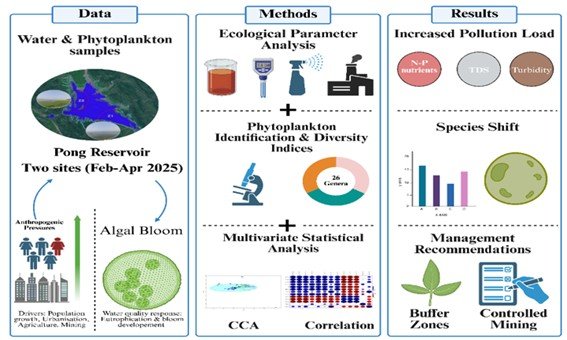
Habitat ecological parameters play a pivotal part in evaluating the richness and abundance of phytoplankton diversity in freshwater ecosystems. Due to a rapid increase in anthropogenic activities, water quality in the riverine system is deteriorating due to numerous natural and anthropogenic factors, such as population growth, urbanization, and industrialization. The main focus of current research was to guesstimate the anthropogenic impact of habitat ecological parameters on phytoplankton diversity in Pong reservoir. The habitat ecological parameters and phytoplankton diversity of Pong reservoir were studied between February 2025 and April 2025 in two sampling zones. Some water quality parameters, i.e., turbidity, total dissolved solids, and biological oxygen demand, showed a small increase in April. Twenty-six genera of phytoplankton were documented, belonging to five groups: eleven genera of Bacillariophyceae, followed by ten genera of Chlorophyceae, three genera of Myxophyceae, one genus of Euglenophyceae, and one genus of Xanthophyceae. Multivariate statistical analysis was applied between habitat ecological parameters and phytoplankton species. Dissolved oxygen showed a positive correlation with phytoplankton diversity and a direct impact on phytoplankton distribution. Lastly, it can be determined that human actions like stream bed mining, development of dams and barrages across the river, etc., negatively influence water quality and the phytoplankton community in the riverine ecosystem. Still, these types of anthropogenic actions can be checked frequently and controlled.Downloads
References
Adekunbi, F., Elegbede, I., Akhiromen, D., Oluwagunke, T., & Oyatola, O. (2018). Impact of Sand Dredging Activities on Ecosystem and Community Survival in Ibeshe Area of Lagos Lagoon, Nigeria. Journal of Geoscience and Environment Protection, 06(02), 112-125. https://doi.org/10.4236/gep.2018.62008.
Bhatti, M., & Latif, M. (2011). Assessment of water quality of a river using an indexing approach during the low‐flow season. Irrigation and Drainage, 60(1), 103-114. https://doi.org/10.1002/ird.549.
Chang, H. (2008). Spatial analysis of water quality trends in the Han River basin, South Korea. Water Research, 42(13), 3285-3304. https://doi.org/10.1016/j.watres.2008.04.006.
Dhembare, A. J. (2011). Diversity Indices of Rotifer from Dynaneshwar Water Rahuri, Ahmednagar, Maharashtra. European Journal of Experimental Biology, 1(3), 139-144.
Effendi, H., & Wardiatno, Y. (2015). Water Quality Status of Ciambulawung River, Banten Province, Based on Pollution Index and NSF-WQI. Procedia Environmental Sciences, 24, 228-237. https://doi.org/10.1016/j.proenv.2015.03.030.
Jindal, R., Gautam, S., & Kumar, R. (2010). Hydrobiological studies on Hillstream Nogli, a tributary of river Sutlej at Rampur Bushahr, District Shimla, Himachal Pradesh, India. J. Aquat. Biol, 25(2): 22–29.
Kale, V. S. (2016). Consequence of temperature, pH, turbidity and dissolved oxygen water quality parameters. International Advanced Research Journal in Science, Engineering and Technology, 3(8), 186–190.
Kamboj, V., & Kamboj, N. (2020). Spatial and temporal variation of zooplankton assemblage in the mining-impacted stretch of Ganga River, Uttarakhand, India. Environmental Science and Pollution Research, 27(21), 27135-27146. https://doi.org/10.1007/s11356-020-09089-1.
Kamboj, V., Kamboj, N., & Sharma, N. (2020). A review on general characteristics, classification and degradation of river systems. In Environmental Degradation: Causes and Remediation Strategies (pp. 47-62). Agro Environ Media - Agriculture and Ennvironmental Science Academy, Haridwar, India. https://doi.org/10.26832/aesa-2020-edcrs-04.
Kamboj, V., Kamboj, N., & Sharma, S. (2017). Environmental impact of river bed mining- a review. International Journal of Scientific Research and Reviews, 7(1), 504–520.
Khanna, D. R., Bhutiani, R., Matta, G., & Ishaq, F. (2012). Physico-chemical and microbiological status of River Asan in Dehradun, Uttarakhand. Environment Conservation Journal, 13(1&2), 145–150.
Khattak, T. M., Bhatti, N. Z., & Murtaza, G. (2005). Evaluation of algae from the effluent of Dandot cement company, Dandot, Pakistan. J. Appl. Sci. Environ. Manage, 9, 147–149.
Kumar V, Malik DS, Sharma AK (2018). Study on Distribution Pattern of Benthic Diversity in Relation to Water Quality of River Ganga and Its Tributaries. Journal of Emerging Technologies and Innovative Research, 5(5), 88–103.
Kumar, A., Thakur, C., Thakur, K., Sharma, A. K., Daroch, R. K., Kumar, R., Kumar, S., & Sharma, A. K. (2026). A systematic review on classification, exposure pathways of micropollutants in the aquatic environment, and its associated human health risks. Journal of Applied Toxicology. https://doi.org/10.1002/jat.70246
Malik DS, Sharma AK, Sharma AK (2020). Status of Zooplankton Diversity, Abundance in Relation to Hydrography of Ganga River and its Tributaries at Rishikesh. Indian Journal of Ecology, 47(3), 739–745.
Malik, D. S., Sharma, A. K., & Bargali, H. (2018). Status of phytoplankton diversity in relation to water quality of Bhagirathi riverine system in Garhwal Himalaya. International Journal of Advanced Science and Research, 3(1), 30–37.
Malik, D. S., Sharma, A. K., & Sharma, A. K. (2020). Current status of macrobenthic diversity and their habitat ecology in River Ganga and its tributaries, Uttarakhand. Journal of Experimental Zoology India, 23(2).
Malik, D., Sharma, A., Kamboj, V., & Sharma, A. (2024). Anthropogenic Impact on Habitat Ecology and Zooplankton Diversity in Ganges Riverine System Using Enviro Assessment Techniques. Proceedings of the National Academy of Sciences, India Section B: Biological Sciences, 94(3), 505-518. https://doi.org/10.1007/s40011-024-01556-w.
Malik, D., Sharma, A., Kumar, S., Kumar, R., Kumar, R., Kamboj, V., & Sharma, A. (2022). Anthropogenic Impact on Fish Faunal Diversity and Their Habitat Ecology in the Ganga River and Its Tributaries, Uttarakhand. In Springer Proceedings in Earth and Environmental Sciences (pp. 53-71). Springer International Publishing. https://doi.org/10.1007/978-3-031-05335-1_4.
Needham JG, Needham PR (1978). A guide to the study of freshwater biology, Halden, Day, Inc. Pul. San. Francisco, 225pp. A guide to the study of freshwater biology: Needham, James G. (James George), 1868-1957.
Obaidy, A. H. M. J., Talib, A. H., & Zaki, S. R. (2015). Application of water pollution index for assessment of Tigris River ecosystem. Int J Adv Res, 3(2), 219–223.
Seiyaboh, E. I., Ogamba, E. N., & Utibe, D. I. (2013). Impact of dredging on the water quality of Igbedi Creek, Upper Nun River, Niger Delta, Nigeria. IOSR Journal of Environmental Science, Toxicology and Food Technology, 7(5), 51-56.
Sharma, A. K., Kamboj, V., Sharma, A. K., Thakur, R., & Sharma, M. (2020). Water quality and its impact on phytoplankton diversity: A case study of Tehri Reservoir, Garhwal Himalayas. Science Archives, 01(03), 166–173. https://doi.org/10.47587/sa.2020.1315
Sharma, A. K., Malik, D. S., & Bargali, H. (2018). Present status of fish diversity and population abundance of selected fish species in Bhagirathi river at Uttarakhand. International journal of creative research thoughts, 6(1), 432–438.
Sharma, A. K., Malik, D. S., & Tyagi, D. (2019). Food and feeding habits of Tor tor (Hamilton, 1822) and Schizothorox richordsonii (Gray, 1832) inhabiting Bhagirathi River, Tehri Garhwal, India. International Journal of Science and Nature, 10(1), 97-103.
Sharma, A., Malik, D., Kamboj, V., & Sharma, A. (2022). Waterbody status of upper Ganga basin and its major tributaries using enviro‐assessment techniques. World Water Policy, 8(2), 216-231. https://doi.org/10.1002/wwp2.12084.
Sharma, P., Shekhar, C., Sharma, A., Kumar, A., Dorach, R., Kumar, R., Kumar, S., & Sharma, A. (2026). A Systematic Review on Biodiversity and Ecological Integrity of Himalayan Freshwater Lakes. Sustainable Environmental Insight, 3(2), 133-151. https://doi.org/10.53623/sein.v3i2.1086.
Shekhar, C., Khosya, R., Thakur, K., Mahajan, D., Kumar, R., Kumar, S., & Sharma, A. (2024). A systematic review of pesticide exposure, associated risks, and long-term human health impacts. Toxicology Reports, 13, 101840. https://doi.org/10.1016/j.toxrep.2024.101840.
Wetzel RG (1983). Limnology. 2nd ed. Saunders College Publishing Co. New York, 767.
Xiong, W., Li, J., Chen, Y., Shan, B., Wang, W., & Zhan, A. (2016). Determinants of community structure of zooplankton in heavily polluted river ecosystems. Scientific Reports, 6(1). https://doi.org/10.1038/srep22043.
Downloads
Published
Issue
Section
License
Copyright (c) 2026 © Author(s)

This work is licensed under a Creative Commons Attribution 4.0 International License.